

Hearing that you or a loved one has “heart failure” can feel overwhelming. It is a term that sounds frightening, but it does not mean the heart has stopped working. Instead, it means the heart is not pumping blood as well as it should.
At our clinical research site, we talk with many patients who are trying to make sense of their diagnosis. One of the most common questions we hear is: “What kind of heart failure do I have, and what does that mean for me?”
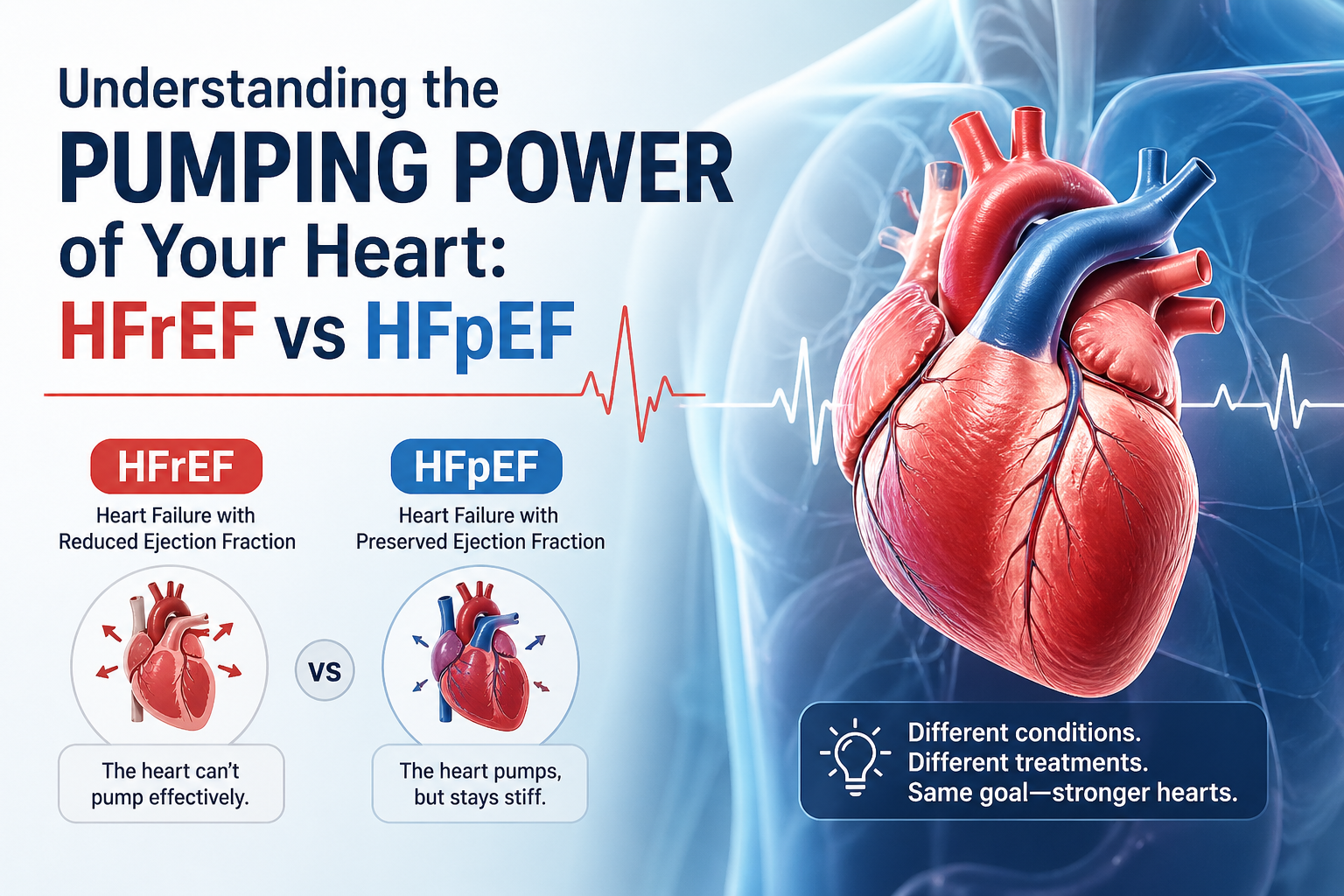
Two of the most common types are HFrEF and HFpEF. These names can sound technical, but the difference between them is easier to understand than it seems. Let us walk through it together in a simple, clear way.
Understanding Ejection Fraction (EF)
Your heart’s main job is to move blood throughout your body. It fills with blood, then squeezes to push that blood out, and repeats this process every second of the day.
Doctors use a measurement called ejection fraction (EF) to see how well your heart is pumping. It tells us what percentage of blood is pushed out of the heart with each beat.
This number helps doctors figure out which type of heart failure a patient has.
HFrEF: The Weak Squeeze
HFrEF stands for Heart Failure with reduced Ejection Fraction. In this type, the heart muscle has become weak and cannot squeeze hard enough.
Imagine trying to squeeze water out of a sponge, but the sponge is worn out and floppy. No matter how hard you try, it just does not push much water out. That is like what happens in HFrEF; the heart cannot pump blood forward effectively.
Some common reasons include:
People with HFrEF often notice:
There are several well-studied medications and devices that can help the heart work better, improve symptoms, and even help people live longer. Many patients feel significantly better once treatment is started and adjusted properly.
HFpEF: The Stiff Fill
HFpEF stands for Heart Failure with preserved Ejection Fraction. In this case, the heart’s squeezing strength looks normal, but there is still a problem.
Think of a balloon that has become stiff. You can still squeeze it, but it is harder to fill it up in the first place. That is what happens in HFpEF; the heart does not relax well enough to fill with blood before the next squeeze. So even though the percentage being pumped out looks normal, the total amount of blood moving through the body may still be too low.
What causes this?
HFpEF is often linked to other health conditions, such as:
What symptoms might you notice?
Interestingly, the symptoms can feel almost the same as HFrEF:
This can make it confusing, and many patients are surprised to learn they have heart failure even though their “pump strength” seems normal.
Comparing the Two Types
Here is a simple way to think about it:
Both affect how blood moves through your body, just in different ways.
Tailoring Your Treatment
Understanding which type of heart failure you have helps your care team choose the best treatment plan.
In both cases, your symptoms, lifestyle, and overall health all play a role in your care.
Research and Hope for the Future
At our site, we are involved in clinical research studies that aim to improve how heart failure is treated. Many of today’s medications exist because patients chose to participate in research.
Right now, there is a strong focus on:
For patients, participating in a study can sometimes offer access to new therapies while also helping others in the future.
Living Well Day-to-Day
No matter the type—HFrEF or HFpEF—many patients share similar day-to-day challenges:
If this sounds familiar, you are not alone. These experiences are very common, and they are exactly why ongoing care and support matter so much.
Simple Habits That Help
While medical treatment is important, there are also everyday habits that can help you feel better and stay stable:
Even small, consistent steps can make a meaningful difference over time.
Final Thoughts
Heart failure can sound like a scary diagnosis but understanding it is the first step toward taking control.
Whether it is HFrEF (a weaker pump) or HFpEF (a heart that does not relax well), both conditions are manageable with the right care, support, and guidance.
At our clinical research site, we are here not just to study these conditions, but to support the people living with them every day. If you ever have questions about your diagnosis, treatment options, or research opportunities, do not hesitate to ask.
You deserve to understand your health and to feel confident in the care you are receiving.